

For decades, imposing complex boundary and initial conditions has been one of the most challenging aspects of solving industrial-scale PDEs. On quantum computers, the challenge is even greater.
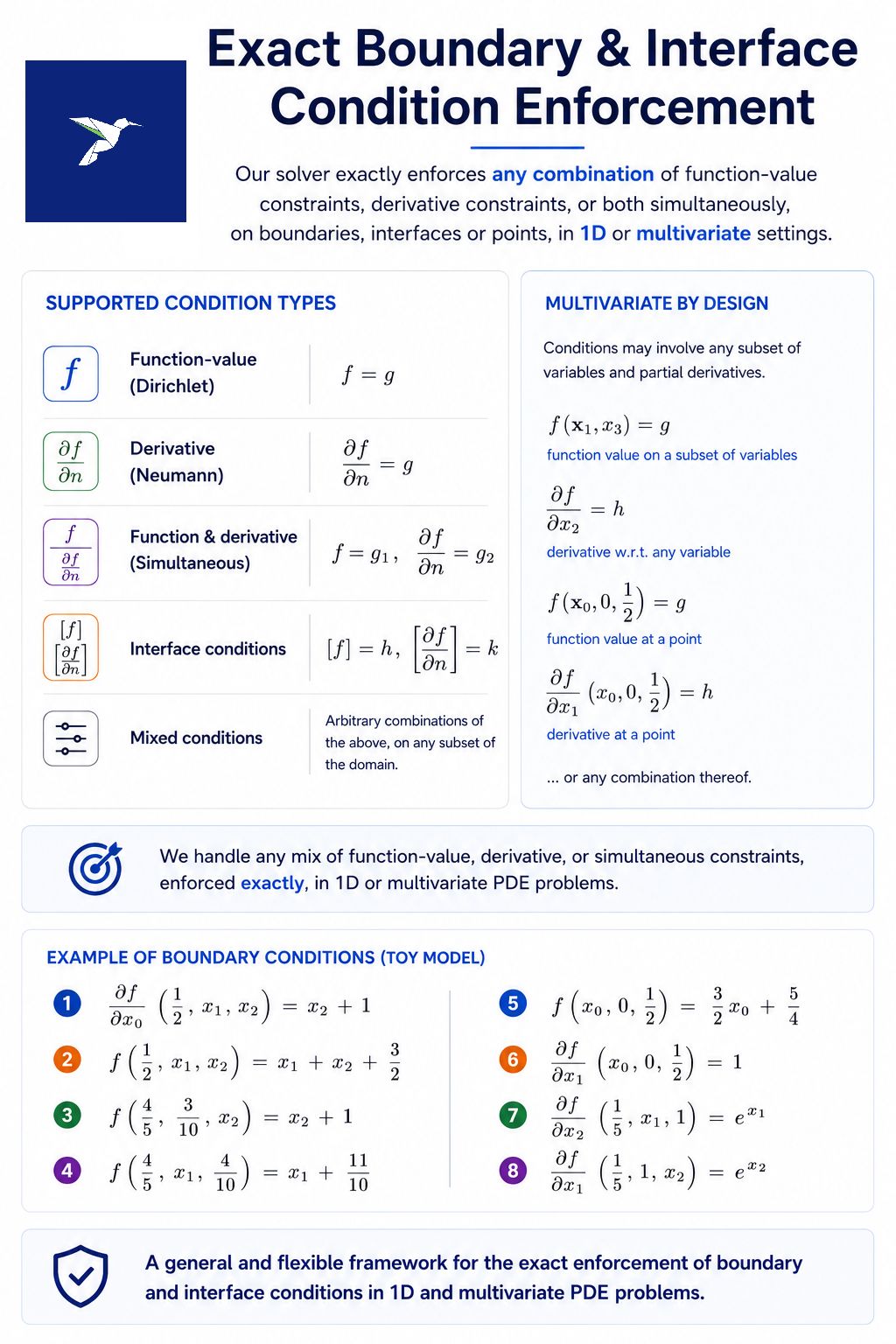
At ColibriTD, after 5 years of intensive R&D in quantum algorithms for industrial simulation, we have developed a general and highly flexible framework that enables the exact enforcement of boundary conditions within H-DES, our quantum PDE solver.
This unique approach removes a major obstacle that has traditionally limited the applicability of PDE solvers. Complex geometries, sophisticated boundary constraints, interfaces between multiple physical domains, multidimensional problems: these are no longer the major roadblocks they once were.This achievement is the one of the latest milestones we were able to reach with our diverse and talented R&D team.
In early 2025, ColibriTD became the first company to successfully solve PDEs on a real quantum computer, demonstrating that industrial simulation on quantum hardware is not merely a long-term ambition, but a technological reality.
Since then, we have continued to strengthen the mathematical and algorithmic foundations of our technology. We have developed a growing portfolio of methods, tools, and solver capabilities that significantly increase the maturity, robustness, and industrial relevance of quantum PDE solving on today's quantum hardware.What is becoming increasingly clear is that progress in quantum computing will not be driven by hardware alone. It will be driven by the algorithms, mathematical frameworks, and numerical methods that transform quantum processors into practical engineering tools.
At ColibriTD, we intend to remain at the forefront of that transformation and continue to strengthen our leadership in quantum computing for industrial simulation.Over the coming months, we will share additional advances that have emerged from our R&D efforts. Some of them address challenges that many still consider fundamental limitations for quantum PDE solvers, or NISQ quantum algorithms in general.
Discover the Latest Blog Posts


