
Simulation drives industrial innovation, but increasingly complex models are pushing classical computing to its limits.
At ColibriTD, we provide a platform that integrates quantum and hybrid quantum-classical solvers into existing simulation software and workflows. Our solutions run on today's quantum hardware and are designed to work seamlessly alongside classical computing resources, enabling companies to accelerate simulations, tackle more complex optimization problems, and prepare for the future of scalable quantum computing.
Universal Multiphysics Solver
(Patent pending)

Quantum Algoritgm Development for today's Quantum Computers

Implement once
Deploy everywhere
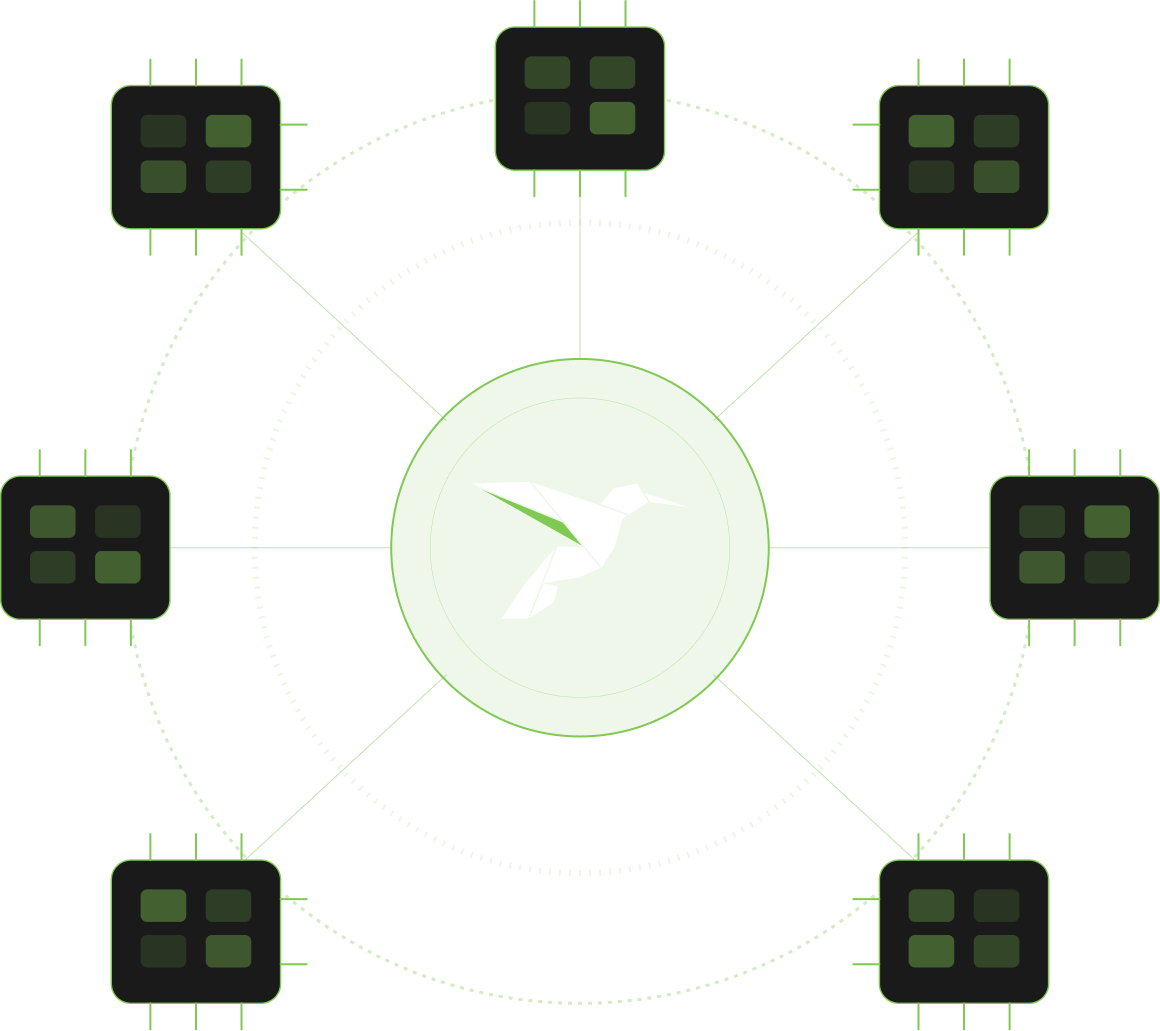
Quantum Algorithm Execution

Accelerate simulation runtimes without compromising accuracy

Reduce computational and energy costs for large-scale modeling

Prepare engineering and R&D teams for the emergence of practical quantum computing

Integrate seamlessly into existing industrial workflows

Our Quantum Innovative Computing Kit platform is design for solving complex PDEs across classical, and quantum architectures. QUICK allows engineers and researchers to run, compare, and prototype hybrid workflows, preparing for quantum advantage while benefiting today from optimized HPC performance.

MPQP ensures interoperability across quantum backends and classical environments. It’s what makes ColibriTD’s technology hardware-agnostic, enabling seamless deployment whether on CPUs, or quantum processors from providers like IBM, AWS, or IQM.




ColibriTD develops a software platform designed to make quantum computing usable for scientific and engineering applications.
The company focuses on problems that appear in large scale scientific simulations, especially those based on partial differential equations used in physics and engineering. These equations appear in many industrial models such as fluid dynamics, electromagnetics, heat transfer, and material science.
To address these challenges, ColibriTD develops several complementary software components.
Multi-Platform Quantum Programming (MPQP) is an open source Python library developed by ColibriTD. It allows researchers and engineers to design, structure, and execute quantum programs in a flexible way. One of its key features is portability across quantum infrastructures. With MPQP, users can deploy and run the same quantum code on multiple hardware backends without rewriting the program each time.
On top of this framework, ColibriTD develops hybrid quantum algorithms such as H-DES (Hybrid Differential Equation Solver) packaged into a platform called Quantum Innovative Computing Kit (QUICK). The H-DES algorithm belongs to the family of Variational Quantum Algorithms and combines classical optimization with parameterized quantum circuits.
ColibriTD also provides ready to use tools such as the Qiskit function QUICK-PDE. This function allows engineers and researchers to experiment with quantum approaches for solving equations used in scientific simulations.
Together, these tools allow teams to:
All ColibriTD technologies are hardware agnostic and can interact with multiple quantum infrastructures. This allows companies to experiment with quantum computing while remaining independent from a specific hardware provider.
MPQP was developed to simplify the development and manipulation of quantum programs in complex research and engineering environments.
When working on quantum algorithms, researchers often need to test different circuit structures, manipulate quantum programs, and connect them with classical optimization or simulation pipelines. Existing tools can become difficult to manage when projects grow in size.
MPQP provides a structured framework to manage and transform quantum programs more efficiently.
Within ColibriTD’s ecosystem, MPQP acts as a foundational software layer. It is used to develop and organize the algorithms implemented in our other solutions.
For example, algorithms such as H-DES (Hybrid Differential Equation Solver) or the Quantum Innovative Computing Kit QUICK) platform rely on this framework to structure circuits, manage parameters, and integrate hybrid quantum classical workflows.
This approach allows faster experimentation and easier integration of quantum algorithms into real scientific computing pipelines.
MPQP can be used in several environments where quantum computing experiments or developments are required. Because it is an open source Python library and hardware agnostic, it allows users to run the same quantum program across multiple quantum backends without rewriting the code.
For researchers, MPQP is a practical tool to benchmark different quantum computers. Research teams often need to compare results across multiple hardware providers such as IBM, IonQ, Pasqal, or Quandela. MPQP allows them to write a quantum program once and execute it on different infrastructures. This simplifies experimentation, reproducibility, and performance comparison across technologies.
For academic environments, MPQP is also useful in teaching quantum computing. In university courses, students often need to experiment with quantum circuits and test them on simulators or real hardware. MPQP provides a simple Python interface that allows students to focus on understanding quantum algorithms rather than adapting their code for each hardware platform.
For industrial teams, MPQP provides a stable development framework to explore quantum computing in real engineering environments. Companies can use it to test algorithms, integrate quantum computations into internal workflows, or connect their experiments to several quantum providers.
This is particularly useful for organizations that collaborate with multiple hardware partners. Instead of maintaining different codebases for each provider, MPQP allows them to keep a single implementation and run it across different infrastructures.
MPQP can also be attractive for companies looking for a quantum software solution developed in Europe and fully controlled from a technological standpoint. This can be important for organizations working in sensitive sectors such as defense, aerospace, or critical infrastructure.
Overall, MPQP provides a flexible development layer for anyone who wants to experiment with quantum computing while remaining independent from a specific hardware platform.
ColibriTD focuses on the intersection between quantum computing and multiphysics simulation.
Multiphysics models couple several physical phenomena such as:
These models generate large mathematical structures such as differential equations and massive linear systems.
ColibriTD develops hybrid quantum algorithms that can be tested on these types of problems. The goal is to explore how quantum computing could reduce computation time, lower simulation costs, and improve model precision once quantum advantage becomes practical.
Thanks to its hardware agnostic approach, ColibriTD allows engineers to experiment with these algorithms across multiple quantum platforms.
Developing and testing quantum algorithms usually requires several components: development tools, simulators, and access to quantum hardware.
ColibriTD provides a platform that allows researchers and engineers to experiment with quantum algorithms while integrating them into scientific computing workflows.
Through tools such as MPQP allow users to use H-DES (or other quantum algorithms) to test hybrid approaches, and run experiments on different quantum backends.
Applying quantum computing to an industrial problem requires several steps.
First, the physical or engineering problem must be translated into a mathematical formulation. This often involves differential equations, linear algebra problems, or probabilistic models.
The second step is identifying quantum algorithms that could address part of this computation.
ColibriTD works with industrial partners to perform this transformation. The company analyzes the mathematical structure of the problem and develops hybrid algorithms adapted to the use case.
Developing quantum applications requires managing circuits, parameters, and hybrid workflows.
MPQP provides a structured framework that simplifies the development of quantum programs and their integration with classical computing environments.
This allows research teams to move faster from algorithm design to experimental testing.
The quantum computing ecosystem includes many hardware technologies.
ColibriTD solutions are hardware agnostic. This means that algorithms developed with our tools can run on multiple quantum infrastructures and simulators.
This flexibility allows companies to test different backends and remain independent from a single hardware provider.