
Solutions
H-DES
Discover our Hybrid Differential Equation Solver
.jpeg)
1st PDE Solver worldwide
At ColibriTD, we are the first in the world to have solved a Partial Differential Equation (PDE) on a real quantum hardware, on IBM Heron 156 Qubits using 50+ Qubits. In addition, we are the first IBM qiskit function for solving PDEs.
Discover our Qiskit function ➜H-DES: Hybrid Differential Equation Solver
Universal
Able to adress all types of engineering simulation problems. From semiconductors to finance.
Multiphysics
Designed to handle multiphysics problems by default without tradeoff between realism and speed.
Linear scaling
Efficient scaling with number of variables and complexity of the problem.
H-DES : a Variational Quantum Algorithm (VQA) for PDEs
What is a VQA?
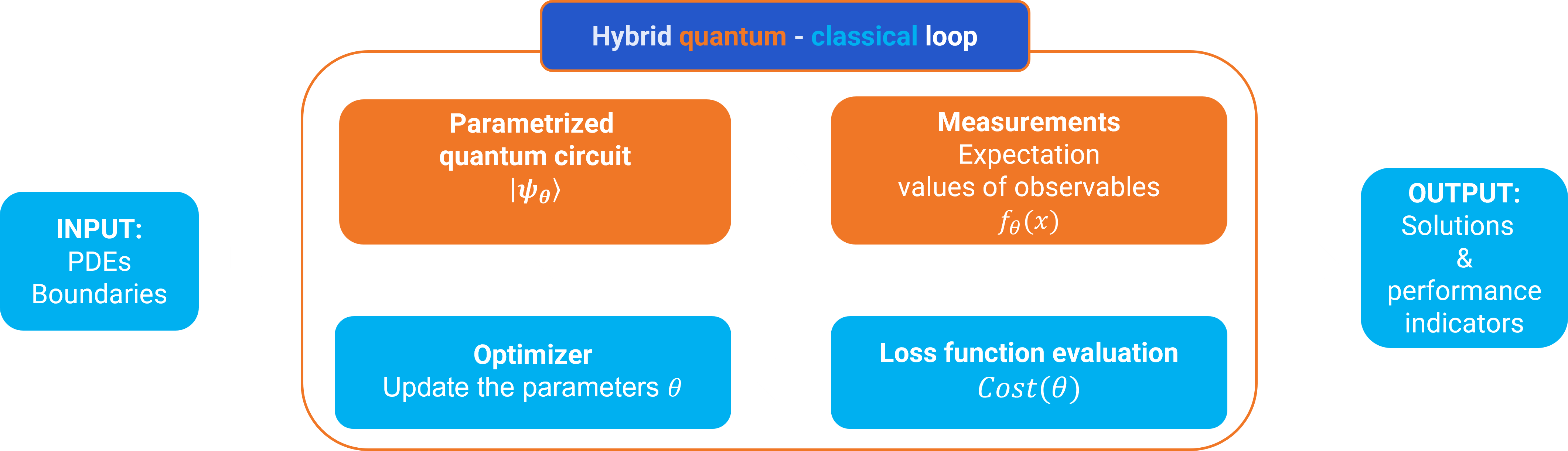
A Variational Quantum Algorithm (VQA) is a hybrid algorithm that combines quantum circuits with classical optimization to solve complex problems more efficiently.
It is especially suited for today’s quantum hardware (NISQ devices), which is still noisy and limited in size. A VQA is built from four key components:
➜ An Ansatz : a parametrized quantum circuit whose structure defines how the algorithm explores possible solutions.
➜ An encoding step : a way to translate a physical, mathematical, or industrial problem into a quantum state.
➜ A cost function : this evaluates how good a candidate solution is, guiding the algorithm toward the optimal result.
➜ A classical optimizer : a traditional computer that adjusts the quantum parameters step by step to minimize the cost function.
The quantum circuit proposes solutions, the classical optimizer improves them, and both work in a loop until convergence.
Why are VQAs powerful?
VQAs are designed for the quantum computers we have today. They use shallow circuits, which makes them compatible with NISQ hardware, and they naturally handle noise better than many traditional quantum algorithms. Because they can adapt to different types of problems, VQAs can act as general-purpose solvers, including for complex simulation tasks such as solving PDE-like multiphysics problems.
A Variational Quantum Algorithm (VQA) is a hybrid algorithm that combines quantum circuits with classical optimization to solve complex problems more efficiently.
It is especially suited for today’s quantum hardware (NISQ devices), which is still noisy and limited in size. A VQA is built from four key components:
➜ An Ansatz : a parametrized quantum circuit whose structure defines how the algorithm explores possible solutions.
➜ An encoding step : a way to translate a physical, mathematical, or industrial problem into a quantum state.
➜ A cost function : this evaluates how good a candidate solution is, guiding the algorithm toward the optimal result.
➜ A classical optimizer : a traditional computer that adjusts the quantum parameters step by step to minimize the cost function.
The quantum circuit proposes solutions, the classical optimizer improves them, and both work in a loop until convergence.
Why are VQAs powerful?
VQAs are designed for the quantum computers we have today. They use shallow circuits, which makes them compatible with NISQ hardware, and they naturally handle noise better than many traditional quantum algorithms. Because they can adapt to different types of problems, VQAs can act as general-purpose solvers, including for complex simulation tasks such as solving PDE-like multiphysics problems.
Discover possible applications using H-DES





You can dive deeper into the theory behind H-DES in our arXiv paper, where we detail the variational quantum algorithm powering our solver. Earlier this year, we became the first to solve a partial differential equation on a real quantum computer using a VQA with more than 50 qubits, leveraging IBM’s Heron processor, you can read the full story on our blog. This milestone demonstrates the scalability of H-DES and its potential to unlock practical quantum advantage for industry-relevant simulations.
Experience FASTER and More Efficient Computing with
Our Quantum Solution


